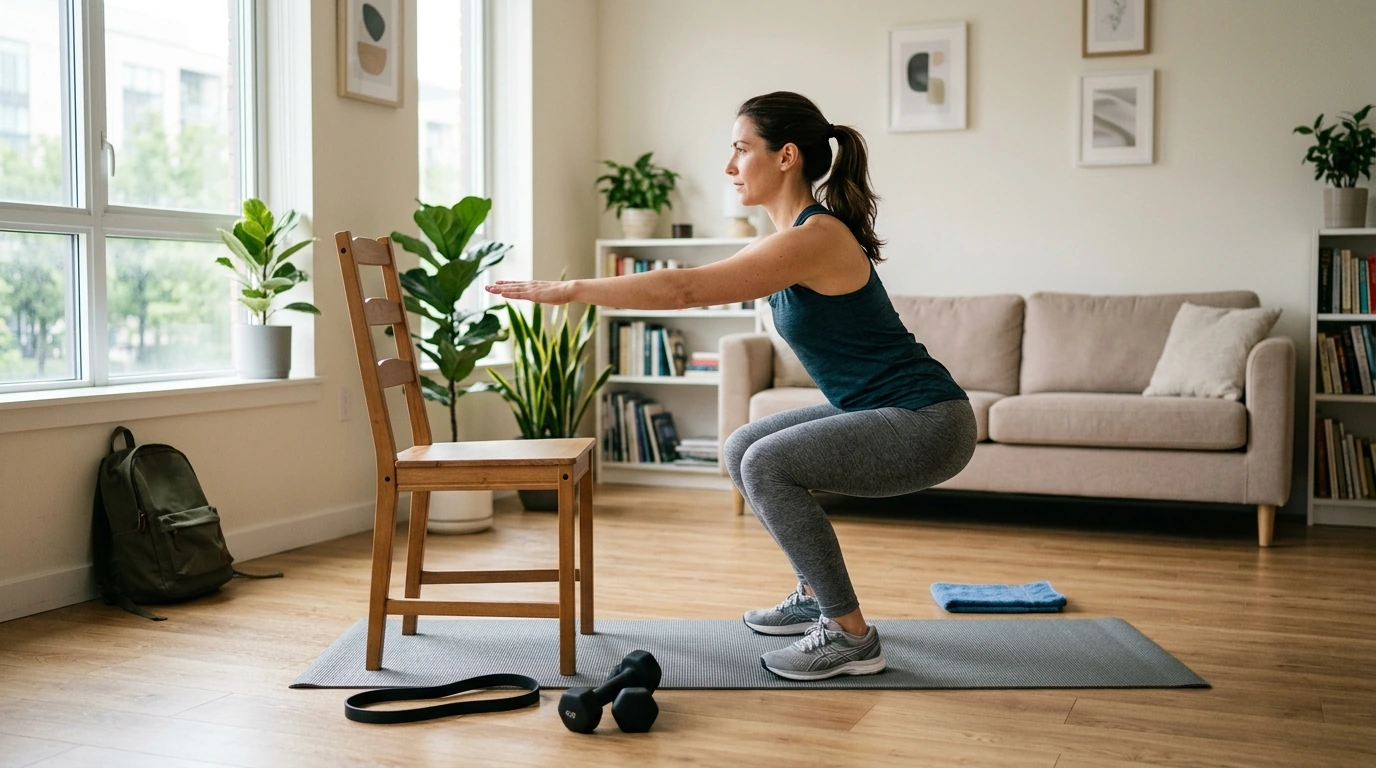
A clear, repeatable routine makes home training easier to start and easier to stick with. This 4-week plan is built around simple movements, minimal equipment, and daily structure that balances strength, cardio, mobility, and recovery—so progress can happen without a gym setup. For more guidance, see Fitness program: 5 steps to get started.
The most useful home plans don’t rely on novelty. They rely on a small set of movement patterns you can repeat, refine, and progress. A smart 4-week schedule also respects real life: busy weeks, limited space, and days when energy is lower. For further reading, see How to Build an Exercise Plan.
For general health targets and weekly movement minimums, the CDC physical activity basics provides a straightforward reference point.
You can run this plan with a chair, a towel, and a small cleared area. Adding a resistance band or light dumbbells makes progression easier, but it’s not required. If you have no weights, a backpack loaded with books or water bottles works surprisingly well for squats, hinges, and rows.
| Training need | Minimal option | Swap if unavailable |
|---|---|---|
| Added resistance | Resistance band or light dumbbells | Backpack with books or water bottles |
| Step-ups / split squats support | Chair/bench | Stairs (hold rail) or sturdy low table edge |
| Core comfort | Yoga mat | Folded towel or carpeted surface |
| Cardio intervals | Jump rope (optional) | Marching/running in place or stair intervals |
Think of the month as four passes through the same “map.” You repeat key patterns, then gradually add a small challenge. That might mean more total reps, shorter rest, or a slightly tougher variation—not an entirely new routine every day.
| Day | Focus | Time target |
|---|---|---|
| Day 1 | Full-body strength | 25–40 min |
| Day 2 | Low-impact cardio + mobility | 20–35 min |
| Day 3 | Lower body + core | 25–40 min |
| Day 4 | Recovery stretch session | 10–25 min |
| Day 5 | Upper body + core | 25–40 min |
| Day 6 | Intervals (cardio) + stretch | 20–35 min |
| Day 7 | Rest or easy walk | 10–45 min |
Keeping the same “shape” each day reduces decision fatigue. Show up, warm up, do the main work, then downshift with breathing and stretching. Over time, this consistency helps form and strength improve together.
Use joint circles, marching, hip hinges, glute activation, and a few easy squats/push-ups to raise your temperature and prepare the range of motion you’ll use that day.
| Item | Details |
|---|---|
| Title | Fit at Home: 4-Week Workout Plan | Minimal Equipment Exercise Guide PDF | Home Fitness eBook with Daily Workouts & Stretches |
| Format | PDF eBook (digital) |
| Price | 21.99 USD |
| Availability | In stock |
Most days run about 20–40 minutes, depending on whether you include an optional finisher. Recovery and stretch-focused days can be as short as 10–15 minutes.
Yes—start with bodyweight variations and use a chair for incline push-ups and step-ups. If you want more resistance later, a loaded backpack is an easy upgrade, and resistance bands are a simple next step.
A good baseline is at least one full rest day per week plus one lighter recovery day. If sleep is low or soreness lingers, keep the schedule but reduce intensity and prioritize walking and mobility.













Leave a comment